Hôtel de Guermantes
In Search of Lost TimeThe Hôtel de Guermantes is more than the residence of a powerful aristocratic family: it is a stage on which access, status, and private desire become legible to an unusually observant narrator. Its courtyard offers a hidden vantage point for a consequential encounter between Palamède de Charlus and Jupien, while its rooms and gardens display the shifting hierarchies of a society divided by the Dreyfus Affair. The house’s significance lies in this double function: it shelters private life and turns social life into performance.
Setting and the Narrator’s View
The narrator watches the Hôtel de Guermantes from positions that change the meaning of the house. Before a reception at the Princesse de Guermantes’s, he keeps vigil for the Duke and Duchess’s return, first from an elevated point with a view toward the Hôtel de Bréquigny, then on the staircase and at a ground-floor window. From behind the window’s blind, he can hear Jupien preparing to go out and watch the courtyard without being seen. The residence is thus introduced not simply as a noble home but as a structure of sightlines, shutters, windows, and concealed observers.
That arrangement makes the courtyard a space between public and private. The narrator can observe its occupants, but his presence is hidden; the people he watches can cross from the street-facing world into the house without knowing that their behavior has acquired a witness. His vigil turns ordinary movements through the courtyard into a possible revelation. The house’s architecture does not merely contain events: it determines who can see them, who remains unseen, and how chance can disclose what social appearances conceal.
The Courtyard Encounter
An unusual visit brings Palamède de Charlus into the courtyard at a time when he would not normally call. He keeps his visiting hours for late afternoon, but the narrator sees him crossing the courtyard on his way to visit Mme de Villeparisis, apparently because she may be indisposed. Jupien, meanwhile, is preparing to leave for work. Their schedules, which have usually kept them apart, briefly coincide.
The first meeting is wordless. Charlus looks intently at Jupien, who stops and returns his gaze; as Charlus alters his posture, Jupien adjusts his own to match it. Charlus’s studied air of indifference and Jupien’s newly assumed, self-assured pose form a silent exchange of recognition. Neither man needs an introduction: their gestures seem to establish an understanding before conversation begins. The scene’s force comes from that immediate mutual response, which contrasts with the ordinary social rules governing the house and its visitors.
The pair go into Jupien’s shop and close the door behind them. The narrator loses sight of them and cannot hear their conversation. He considers reaching a vacant neighboring shop by way of the cellars, a concealed and safer route, but instead crosses the courtyard openly, close to the walls. He later associates his choice with impatience, the memory of watching Mlle Vinteuil at Montjouvain, and the imagined courage he had drawn from accounts of travel and exploration. The house’s hidden lower passage and open courtyard offer contrasting routes; the narrator chooses the riskier one, making his own act of watching part of the episode’s structure.
Rank, Access, and Reception
The Hôtel de Guermantes is also a system of social admission. Palamède de Charlus has solemnly claimed that entry to Guermantes houses must come through him, presenting himself as a gatekeeper to the family’s world. When the narrator attends a reception at the Princesse de Guermantes’s without following that route, Charlus is angered: the narrator’s presence contradicts his claim to control access. His authority is still substantial, but the narrator recognizes that Charlus’s threats of exclusion no longer command the power they once did.
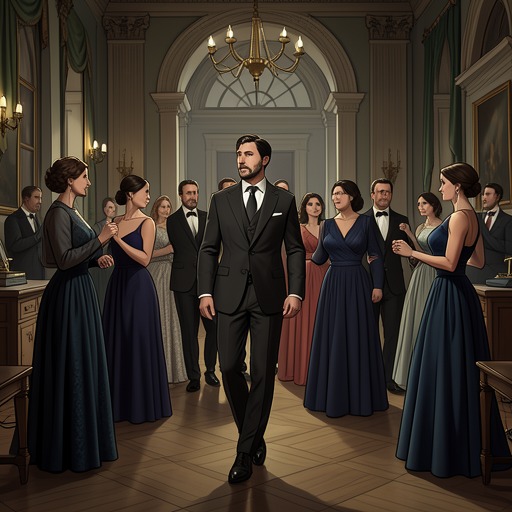
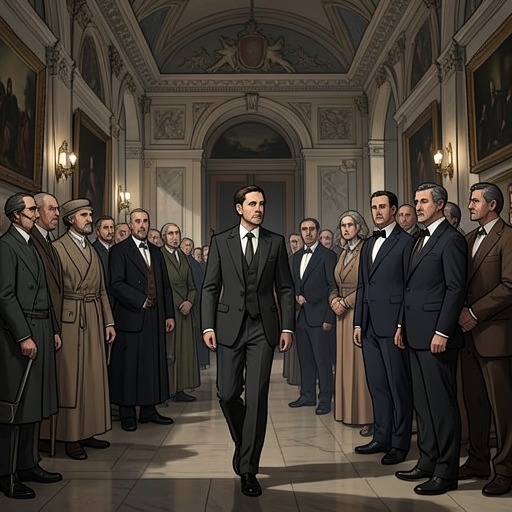
At the reception, Charlus places himself where guests passing between house and garden must greet him. He names them one by one and offers apparently solicitous comments, turning the flow of arrivals into an occasion for displaying his command of names and his central place in the gathering. His manner combines aristocratic pride with an aesthetic conception of the event: he imagines the reception as a scene from an opera or a painted procession. The house’s staircase and garden entrance become a ceremonial threshold, and Charlus performs his rank there as if he were presiding over a court.
When the Prince is absent, the gathering around Charlus grows larger, and the narrator encounters him on the stairs. Charlus tells him that it is good to see him there, but turns the welcome into exaggerated sarcasm, laughing at the circumstance he could not prevent. He then softens, pats the narrator’s shoulder, and asks whether he has seen the fountain. His changing tone reveals the tension between personal affection and wounded authority: the narrator is welcome, yet his independent access remains a challenge to Charlus’s social claims.
Political Change in the House’s Orbit
The Hôtel de Guermantes’s social world is affected by the Dreyfus Affair, whose divisions make personal loyalty and public position difficult to separate. The Duke de Guermantes regards Charles Swann’s support for Dreyfus as a profound betrayal. In his view, Swann is not an inexperienced young man but a respected, level-headed figure whose position gives his political choice a wider social consequence. The Duke also treats Swann’s support as evidence of Jewish solidarity, generalizing from one person to an entire group. His reaction shows how political opposition has become a test of social belonging and a source of antisemitic suspicion.
Swann recounts to the narrator how the Prince de Guermantes had avoided him because he expected their views on the Affair to differ. The Prince explains that he found the subject painful and describes earlier encounters in which political declarations threatened to offend him. Yet he also relates that information from General de Beauserfeuil had led him to suspect grave irregularities in the trial. In the Guermantes circle, political judgment is therefore shaped not only by inherited loyalties but by new reports, conversations, and pressures among acquaintances.
The Duke’s own reversal makes that instability especially clear. After a spa cure, he returns as a Dreyfusard, astonishing friends who had known him as a vehement opponent. His change follows his meeting with an Italian princess and her sisters-in-law, whose political arguments he initially resists and then gradually adopts. When he brings them evidence he thinks will damage Dreyfus, they answer his claims; in the end, he returns to Paris convinced that Dreyfus should be acquitted for lack of evidence. The episode makes the house’s political world part of a broader pattern in which conviction can be reshaped through social contact and argument.
A House of Exposure and Performance
Across these scenes, the Hôtel de Guermantes holds together two kinds of visibility. In the courtyard, a concealed observer witnesses a private recognition that the men involved do not announce to society. At receptions, guests make themselves visible through greetings, titles, and positions, while Charlus tries to turn presence into proof of authority. The same residence that enables secrecy also stages display.
The narrator’s delayed account of the courtyard encounter reinforces the house’s role as a place where meaning arrives after the event. At first he sees only an unexpected meeting, a closed shop door, and the loss of a view. He explains that reality can remain effectively invisible until chance removes what obscures it. The Hôtel de Guermantes consequently serves as an architectural image of the novel’s social knowledge: spaces and gestures are observed before their significance is understood, and the distinction between public identity and private life is repeatedly tested within the same walls.